Clan MacKenzie
Crest & Motto
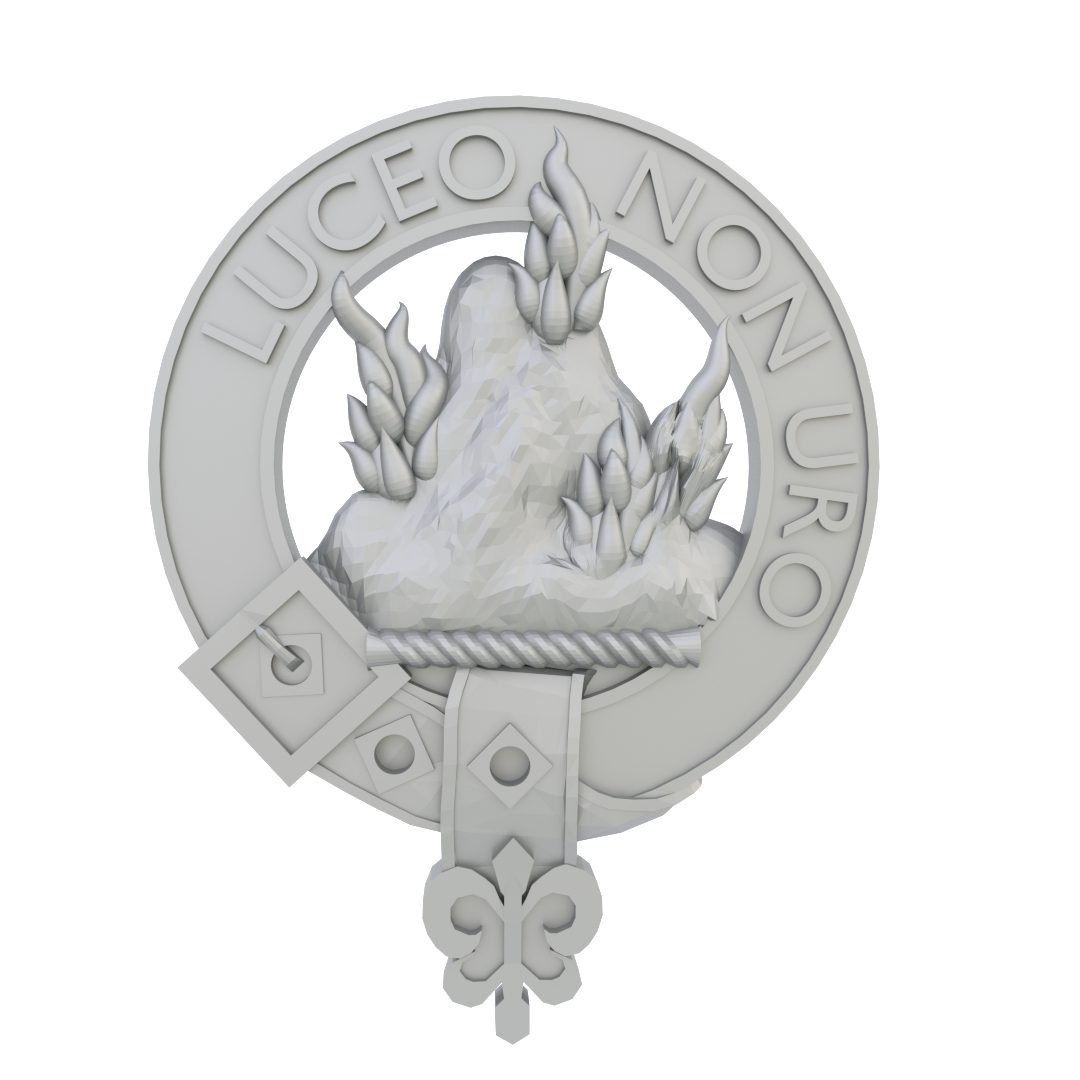 The MacKenzie clansman’s crest shows a mount in flames, and the motto is Luceo Non Uro — “I shine, not burn”. (The chief’s personal crest is the sun in splendour; the burning mountain is the badge worn by clansfolk.)
History
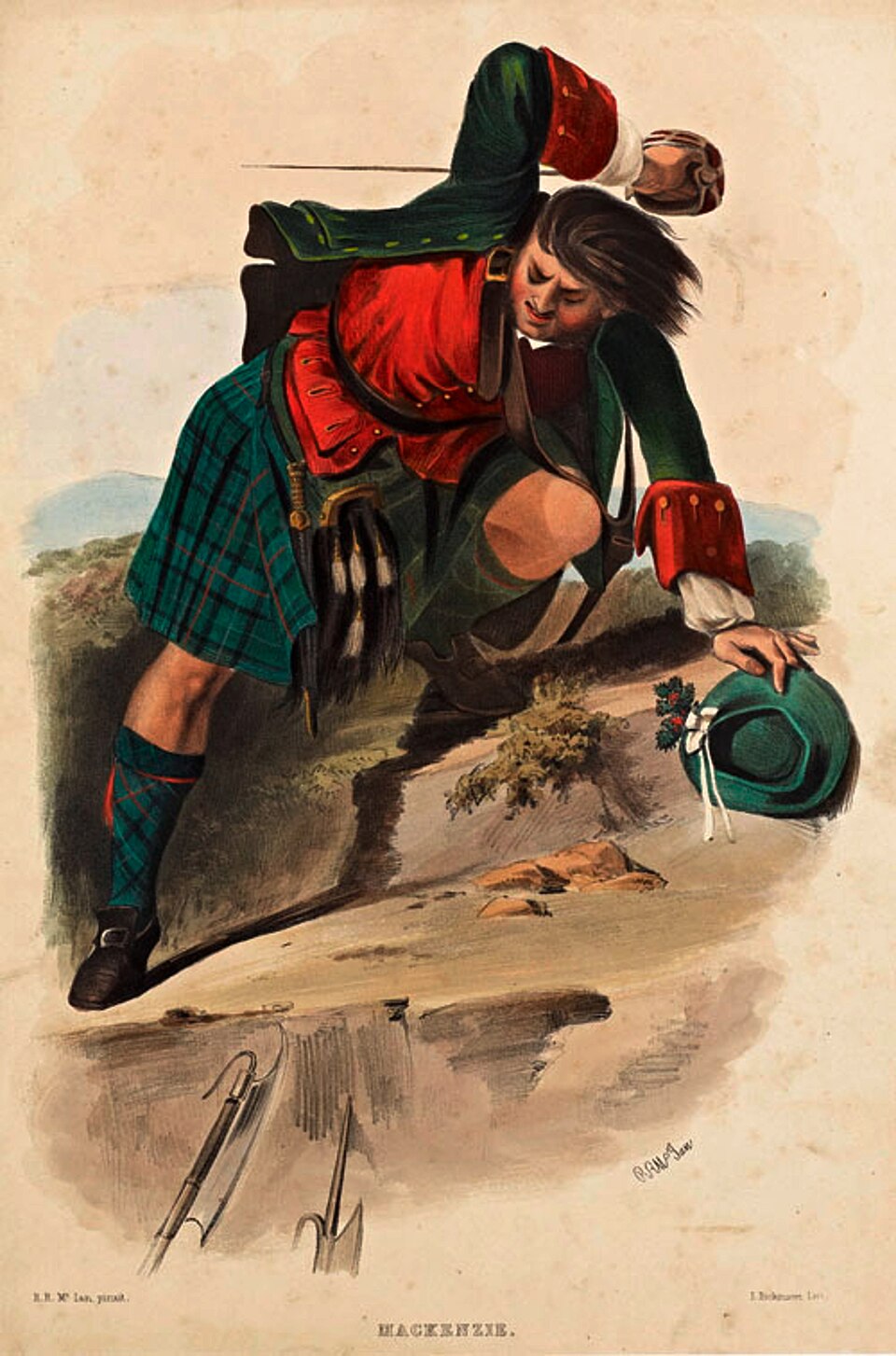
MacKenzie is the anglicised MacCoinnich, “son of Coinneach (Kenneth)” — a Gaelic name meaning “fair” or “bright one”. The clan descends from the native Gaelic lords of Kintail in Wester Ross; a once-popular legend tracing the chiefs to an Irish-Norman knight, Colin FitzGerald, has been discredited by historians. The original heartland was Kintail, guarding Loch Duich from Eilean Donan Castle.
From the 15th century, under chiefs such as Alexander “the Upright”, the MacKenzies expanded steadily eastward across Ross-shire. They defeated the MacDonald Lords of the Isles at the Battle of Park around 1488, and by the early 17th century controlled a swathe of northern Scotland from the Isle of Lewis to the Black Isle and Cromarty — one of the most powerful Highland clans. The chiefs were created Earls of Seaforth in 1623.
The clan paid heavily for its Jacobitism. William, 5th Earl of Seaforth, led over a thousand MacKenzies in the 1715 rising and was wounded at Glen Shiel in 1719, forfeiting his titles before a later pardon. In 1745 the clan split — the Seaforth line stayed out, while the Earl of Cromartie led MacKenzies for the Jacobites and was captured in 1746. The Seaforth Highlanders regiment was raised from clan lands in 1778. The senior Seaforth line ended in 1815 with the death of Francis Humberston Mackenzie — an end famously foretold in the legend of the Brahan Seer — and the chiefship lay dormant from 1907 until 1980, when the Lord Lyon recognised the Earl of Cromartie as chief, known as Cabarfeidh, “the stag’s antlers”.
Clan Chief
The current chief is John Ruaridh Grant Mackenzie, 5th Earl of Cromartie, Cabarfeidh, chief since 1989. The clan seat is Castle Leod at Strathpeffer.
Clan Tartan
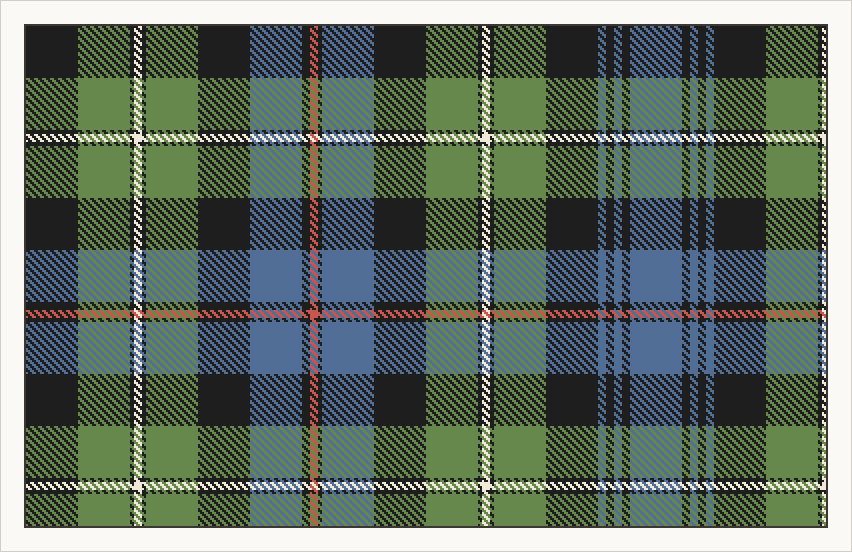
Septs and Family Names
Many family names are counted among the septs of Clan MacKenzie. If your surname appears here, your family history leads back to this clan: Charles, Charleson, Clunes, Clunies, Cross, Iverach, Iverson, Ivory, Kenneth, Kennethson, Kinnach, Kynoch, MacAulay, Macaweeney, MacBeath, MacBeolain, MacBeth, MacConnach, MacCure, Maceur, MacIver, MacIvor, MacKenna, MacKenney, MacKerlich, MacKinna, MacKinney, MacKinnie, MacKinzie, MacLeay, MacMurchie, MacMurchy, MacQueenie, MacThearliach, MacVanish, MacVennie, MacVinish, MacVinnie, MacWeeny, MacWhinnie, Makiver, McKenzie, McKinzie, Murchie, Murchison, Smart, Stephan, Tuach, Young.
Unsure how clan names, crests and septs work? Our guide to Scottish clan names explains the rules.
Further reading
The Clan Mackenzie wiki page is a good starting point.
Clan Mackenzie Society of Scotland & the UK
Clan MacKenzie Society (North America)
Clan Mackenzie Society in Australia
Clan MacKenzie Society of New Zealand
The MacKenzie Crest as a 3D Model
You can download the MacKenzie crest as a 3D model file (£10–£25) and print it on any 3D printer, or carve it in wood on a CNC machine.
See the MacKenzie lands — from Kintail to the Black Isle — on our interactive clan map of Scotland.