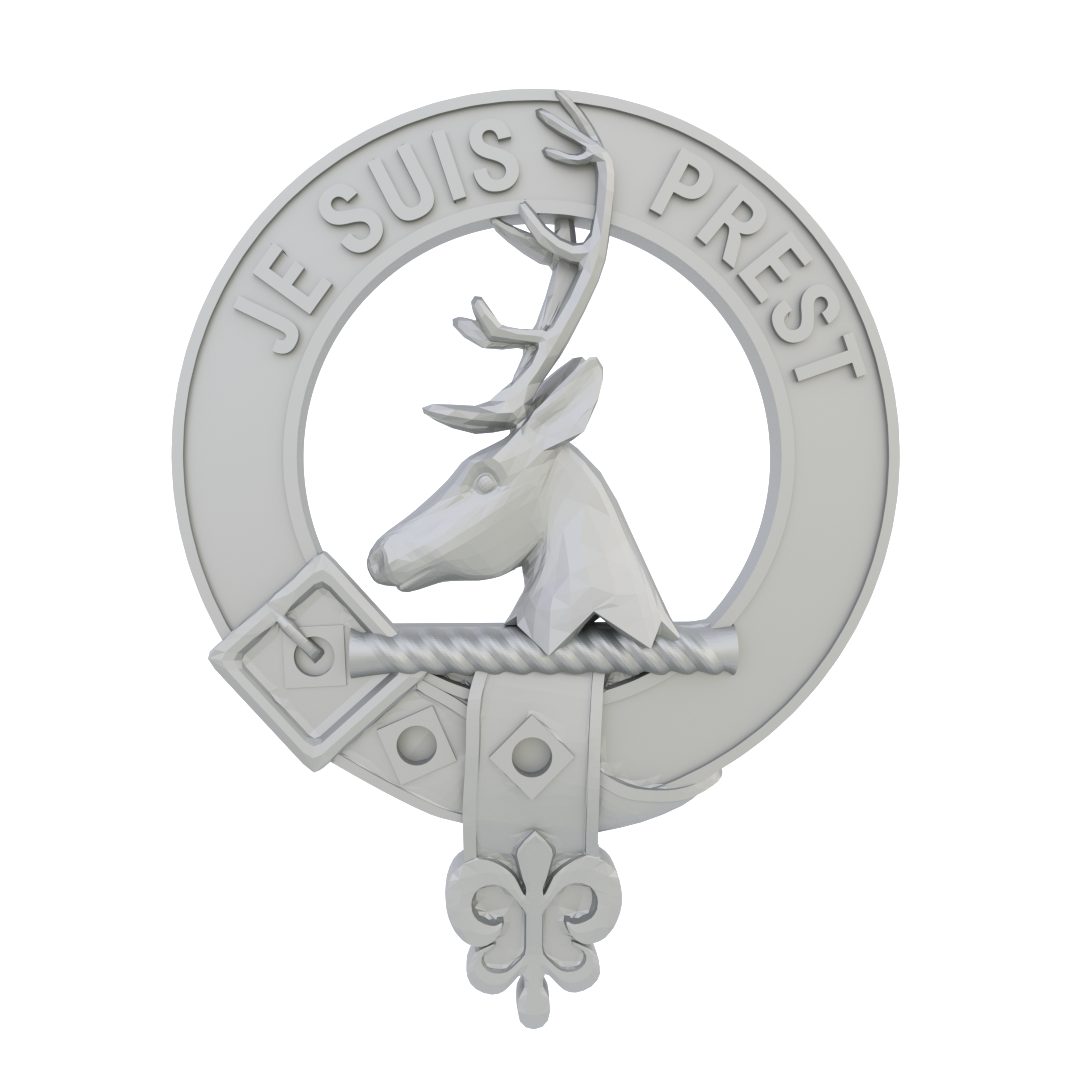
The crest of Clan Fraser of Lovat shows a buck’s head. The clan motto is Je Suis Prest — old French for “I am ready”.
History
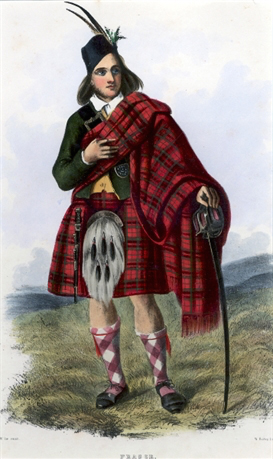
The Fraser plate from R.R. McIan’s The Clans of the Scottish Highlands, 1845.
Clan Fraser has held lands in the Inverness area since the 13th century. Of French, Norman origin and arriving in Scotland as part of a large influx of Norman families in the late 12th Century and early 13th centuries during the reign of King William I. One branch of Frasers settled in Buchan in the North East corner of Scotland in the town of Faithlie, now called Fraserburgh. There are distinct Highland and Lowland branches of the Clan.
Sir Simon Fraser was a close comrade-at-arms of William Wallace. Even after Wallace’s capture and execution in 1305, he refused to swear fealty to Edward. The following year, Simon Fraser himself was captured and executed in the same grisly fashion as William Wallace. Frasers fought alongside King Robert the Bruce at the battle of Bannockburn (1314). The name Simon is very common for the Chief of the Frasers of Lovat giving rise to the Gaelic name MacShimidh, or sons of Simon.
Jacobite Rebellions of 1715 and 1745
The 11th Lord Lovat, “the fox” supported the British Government during the 1715 Jacobite rebellion. Afterwards a number of Independent Highland Companies were formed to keep order in the Highlands. However, in 1740 there was some suspicion amongst the British that these Highland Companies had been infiltrated by Jacobitism and Lord Lovat was stripped of his Company of Highlanders. In the 1745 rebellion the 11th Lord Lovat supported the Jacobite cause, reportedly as a consequence of being stripped of his Highland Company a few years before. In the aftermath to the rebellion in 1747, the 11th Lord Lovat, “the fox”, was captured, convicted of treason and beheaded on Tower Hill in London.
Like many Highland clans, Clan Fraser played a prominent role in the British Army. The 78th Fraser Highlanders comprising fourteen hundred men served in Canada during the capture of Quebec and also during the American Wars of Independence. In 1899, during the Boer War, the 14th Lord Lovat raised the Lovat Scouts, a very famous unit within the British Army attached to the Black Watch.
Today, Frasers can be found all over the world, especially across North America, Australia and New Zealand.
Clan Chief(s)
By decree of the Court of the Lord Lyon in 1984, the Chief of the “Name and Arms of Fraser“ is Flora Fraser, 21st Lady of Saltoun. She is also the head of the Frasers of Philorth.
Clan Fraser of Lovat is a distinct branch of Clan Fraser and has its own Clan Chief recognized by the Lord Lyon King of Arms. The Chief of Clan Fraser of Lovat is Simon Fraser, the 18th Lord Lovat and 25th MacShimidh.
Clan Tartan
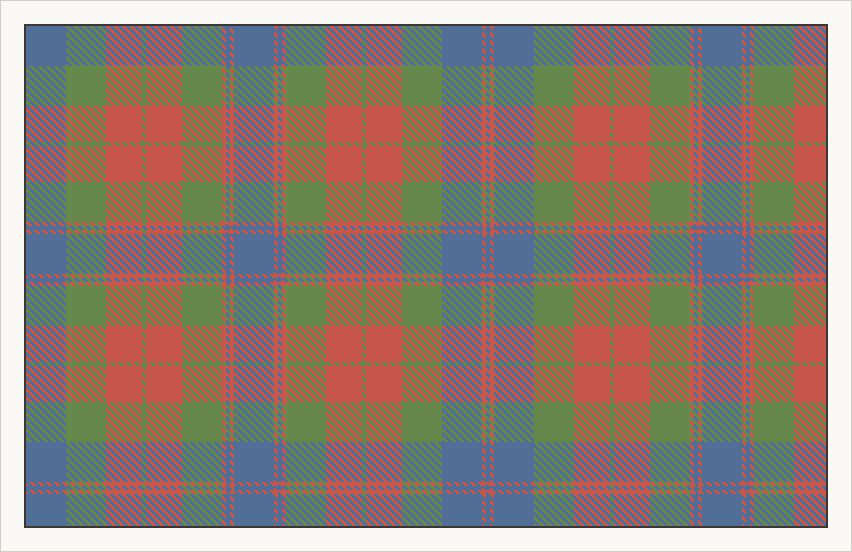
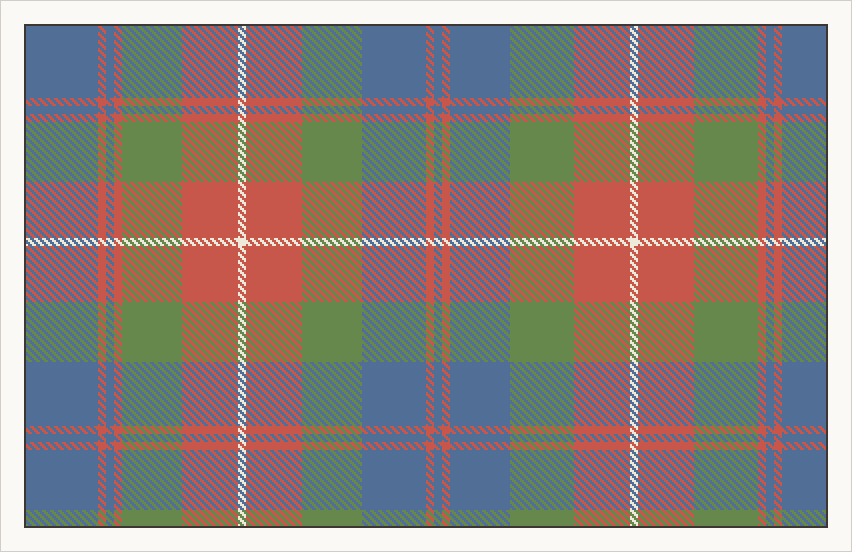
Clan Fraser has more than one tartan. The red Fraser shown first is the older sett, recorded by the weavers Wilsons of Bannockburn around 1800. The Fraser of Lovat sett below it was recorded in 1893 and is associated with the Lovat line; it shares the red ground but arranges the green and blue differently and adds a white overcheck. Both are correct wear for Frasers.
The red Fraser tartan in ancient colours. Sett recorded by Wilsons of Bannockburn around 1800.The Fraser of Lovat tartan in ancient colours. Sett recorded in 1893.
Septs and Family Names
Many family names are counted among the septs of Clan Fraser. If your surname appears here, your family history leads back to this clan: Bissett, Brewster, Cowie, Frew, Frissel, Frizell, MacCimmie, MacGruer, MacKim, MacKimmie, MacShimes, MacSimon, MacTavish, McCoss, Oliver, Sim, Sime, Simon, Simpson, Sims, Simson, Syme, Symon, Twaddle, Tweedie.
The Wikipedia entry for Clan Fraser of Lovat has lots of interesting information about the Highland branch of the Clan and links to the other branches.
This chat gives informal guidance only, it does not generate binding commitments. For a binding quote, please contact us directly at sales@celtic3d.com. By continuing, you consent to us logging the conversation for 180 days.
To provide the best experiences, we use technologies like cookies to store and/or access device information. Consenting to these technologies will allow us to process data such as browsing behaviour or unique IDs on this site. Not consenting or withdrawing consent, may adversely affect certain features and functions.
Functional
Always active
The technical storage or access is strictly necessary for the legitimate purpose of enabling the use of a specific service explicitly requested by the subscriber or user, or for the sole purpose of carrying out the transmission of a communication over an electronic communications network.
Preferences
The technical storage or access is necessary for the legitimate purpose of storing preferences that are not requested by the subscriber or user.
Statistics
The technical storage or access that is used exclusively for statistical purposes.The technical storage or access that is used exclusively for anonymous statistical purposes. Without a subpoena, voluntary compliance on the part of your Internet Service Provider, or additional records from a third party, information stored or retrieved for this purpose alone cannot usually be used to identify you.
Marketing
The technical storage or access is required to create user profiles to send advertising, or to track the user on a website or across several websites for similar marketing purposes.

 Clan Fraser has held lands in the Inverness area since the 13th century. Of French, Norman origin and arriving in Scotland as part of a large influx of Norman families in the late 12th Century and early 13th centuries during the reign of King William I. One branch of Frasers settled in Buchan in the North East corner of Scotland in the town of Faithlie, now called Fraserburgh. There are distinct Highland and Lowland branches of the Clan.